|
| Home > News |
Undergraduates from Wuhan University Publish First-author Paper on LiDAR-based Gait Recognition in CVPR 2026Author:Administrator Source:website Time:2026-03-19 09:25:31Recently, Shenyin Xu and Yishan Wang, undergraduate students from the Class of 2023 at the Electronic Information School, Wuhan University, published their research as co-first authors at the IEEE/CVF Conference on Computer Vision and Pattern Recognition (CVPR) 2026. The paper is titled "MS²Gait: A Multi-Scale Spatio-Temporal Fusion Network for LiDAR-based Gait Recognition." The study was supervised by Professor Xin Tian and Dr. Rui Liu (Postdoctor), with its preliminary phase supported by the National Undergraduate Innovative Training Program.
CVPR is globally recognized as the premier academic conference in computer vision. It is categorized as a Grade-A recommended venue by the China Computer Federation (CCF) and consistently ranks as the top publication in Engineering and Computer Science according to Google Scholar Metrics. For the 2026 edition, the conference received over 16,000 valid submissions with an acceptance rate of approximately 25.4%.
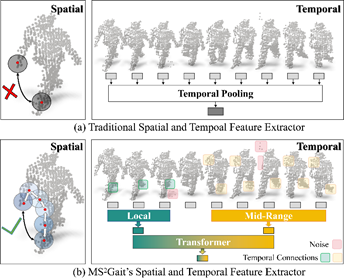
Gait recognition, a biometric technology that identifies individuals by their walking patterns, offers significant advantages for intelligent security due to its long-range and non-contact nature. Compared to traditional camera-based methods, LiDAR point cloud data provides robust geometric information that is immune to illumination changes and inherently preserves privacy. However, existing methods struggle with two core challenges: the inability to model long-range semantic correlations between body parts and the difficulty in handling temporal heterogeneity caused by varying cadences.
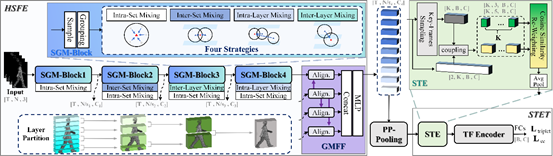
To address these issues, the authors proposed the MS²Gait framework, featuring two core innovations: 1. Hierarchical Spatial Feature Extraction (HSFE): This module introduces four complementary interaction strategies to capture cross-scale semantic dependencies and recover structural information under occlusion. 2. Similarity-based Temporal Enhancement Transformer (STET): This strategy employs diversity-driven keyframe selection to reduce redundancy and utilizes multi-scale cosine similarity aggregation to dynamically weight frame contributions.
Extensive evaluations on large-scale datasets SUSTech1K and FreeGait demonstrate that MS²Gait achieves state-of-the-art performance, reaching 93.5% and 83.1% Rank-1 accuracy, respectively. It exhibits exceptional robustness in challenging scenarios, such as when subjects are carrying bags or holding umbrellas.
The co-first authors, Shenyin Xu and Yishan Wang, are both students in the school's elite pilot programs. Shenyin Xu is a student in the Artificial Intelligence Pilot Class and a probationary member of the CPC. He has demonstrated exceptional equilibrium between academic rigor and innovative research. He is a recipient of the prestigious Yu Gang & Song Xiao Scholarship and the FiberHome Communication Scholarship. He served as a core member of the team that won the National Gold Medal in the China International College Students’ Innovation Competition. He also earned a National Second Prize in the Contemporary Undergraduate Mathematical Contest in Modeling, reflecting his solid foundation in algorithmic modeling and complex problem-solving. Yishan Wang is a student in the "Chasing Light" Innovative Talent Pilot Class and a probationary member of the CPC. A recipient of the National Scholarship and the Chenggeru First-Class Scholarship, Yishan has consistently ranked at the top of his cohort. His technical versatility is evidenced by his National First Prizes in both the National English Competition for College Students and the IC-Innovation Challenge.
The outstanding research achievements of these two students are a testament to the school's ongoing commitment to deepening its cultivation system for top-tier innovative talents. Guided by national strategic needs and frontier technological advancements, the school fosters undergraduate research through its differentiated Pilot Class initiatives. The Artificial Intelligence Pilot Class focuses on core AI technologies, providing a globally-aligned curriculum that empowers students with a robust theoretical foundation and modern innovative thinking. Meanwhile, the "Chasing Light" Innovative Talent Pilot Class leverages the school’s strengths in optoelectronic information, implementing a research-immersive mentorship system and utilizing national-level engineering centers to bridge the gap between academic theory and high-level competition. This multidimensional cultivation mechanism provides a solid platform for students to explore the frontiers of science and technology, contributing to the nation's goal of technological self-reliance and excellence in the global AI landscape.
|
| © CopyRight 2015-2016 Electronic Information School,Wuhan University Copyright © Electronic Information School,Wuhan University,Luojiasha,Wuhan,China Post:430072 Tel:027-68778456 027-68756275 |